

Solitaire is one of the most widely played card games in the world. It’s simple to learn, relaxing to play, and easy to enjoy on both physical cards and digital platforms.
If you’re new to the game, understanding the rules of Solitaire is the first step toward mastering it. In this guide, you’ll learn the basic rules, how the game board works, and the core mechanics that allow you to win.
If you want to practice while learning, you can start playing here:
What Are the Rules of Solitaire?
The goal of Solitaire is to move all cards into four foundation piles organized by suit from Ace to King.
Each suit must be built in this exact order:
Ace → 2 → 3 → 4 → 5 → 6 → 7 → 8 → 9 → 10 → Jack → Queen → King
Once all four foundation piles are complete, the game is won.
Understanding the Solitaire Layout
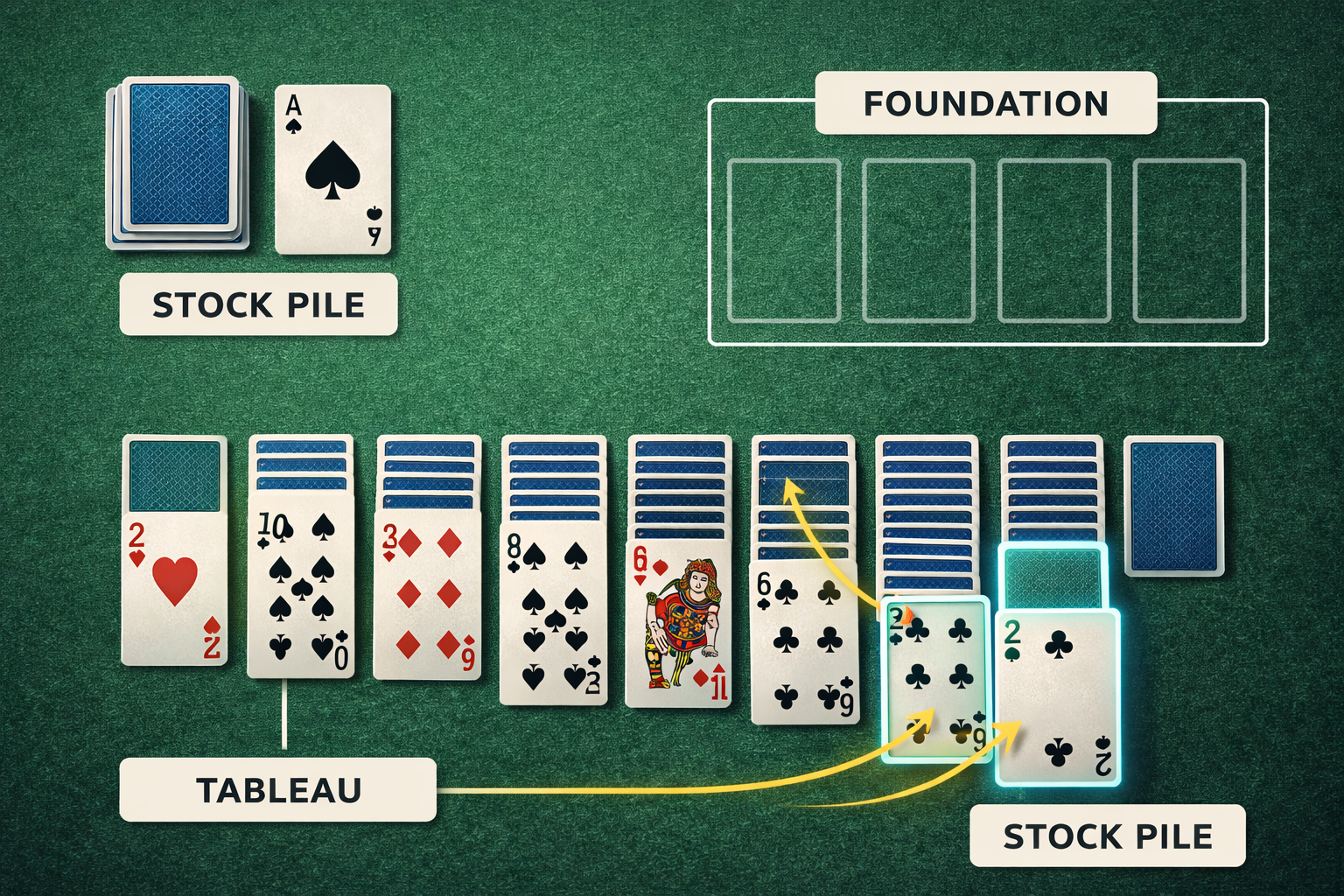
A standard Solitaire game board contains four main areas.
Tableau (Main Playing Area)
The tableau consists of seven columns of cards arranged horizontally.
Each column begins with a different number of cards:
Column 1: 1 card
Column 2: 2 cards
Column 3: 3 cards
Column 4: 4 cards
Column 5: 5 cards
Column 6: 6 cards
Column 7: 7 cards
Only the top card in each column is face-up at the beginning of the game.
The rest remain face-down until uncovered.
Stock Pile
The remaining cards form the stock pile.
Players draw cards from the stock pile when they run out of moves in the tableau.
Waste Pile
Cards drawn from the stock pile are placed into the waste pile.
You can move these cards to either:
- the tableau
- the foundation piles
if they follow the rules of the game.
Foundation Piles
The four foundation piles are where cards must ultimately be placed.
Each pile represents one suit.
Example:
Hearts foundation
A♥ → 2♥ → 3♥ → … → K♥
Spades foundation
A♠ → 2♠ → 3♠ → … → K♠
Core Solitaire Rules
Understanding the following rules is essential to playing the game correctly.
Rule 1: Alternate Card Colors
Cards in the tableau must be stacked in alternating colors.
Example:
Red 9 → Black 8 → Red 7 → Black 6
Two cards of the same color cannot be stacked together.
Rule 2: Build Cards in Descending Order
Cards must be placed from higher value to lower value.
Example:
King → Queen → Jack → 10 → 9 → 8
Rule 3: Only Kings Can Fill Empty Columns
When a tableau column becomes empty, only a King (or a stack beginning with a King) can be placed there.
Empty spaces are valuable because they allow you to reorganize the board.
Rule 4: Move Cards to the Foundations
Cards should be moved to the foundation piles whenever possible.
Foundations must always be built in ascending order within the same suit.
Example:
Ace → 2 → 3 → 4 → … → King
How a Solitaire Game Progresses
Most Solitaire games follow a similar pattern.
Step 1: Reveal Face-Down Cards
Whenever possible, move cards to uncover hidden cards beneath them.
Revealing new cards increases your possible moves.
Step 2: Organize Tableau Columns
Build descending alternating stacks.
This allows you to rearrange cards strategically.
Step 3: Use the Stock Pile
If you cannot make a move, draw cards from the stock pile.
These cards may open new opportunities.
Step 4: Move Cards to Foundations
Continue transferring cards to foundation piles until all four suits are complete.
Common Beginner Mistakes
Many new players struggle with Solitaire because of a few common mistakes.
Moving Cards Too Quickly
It’s tempting to make the first available move, but sometimes waiting leads to better outcomes.
Filling Empty Columns Too Soon
Empty tableau spaces are powerful tools.
Only fill them when it helps reveal hidden cards or create better moves.
Ignoring the Stock Pile
The stock pile often contains cards that unlock the entire board.
Check it regularly.
Solitaire Strategy Tips
Although luck plays a role, these strategies improve your chances of winning.
Prioritize Hidden Cards
Always aim to reveal face-down cards first.
This creates the greatest number of possible moves.
Move Aces and Twos Early
Starting foundation piles early clears space on the board.
Plan Two Moves Ahead
Before making a move, consider how it will affect the rest of the board.
Good players always think ahead.
Play Solitaire Online
Once you understand the rules, the best way to improve is to play.
Try a game instantly:
▶ Play Classic Solitaire
▶ Play Spider Solitaire
Online games allow you to practice strategies and improve quickly.
Frequently Asked Questions
What is the goal of Solitaire?
The goal is to move all cards into four foundation piles organized by suit from Ace to King.
Are all Solitaire games solvable?
No. Some card arrangements make it impossible to win regardless of strategy.
What is the easiest Solitaire version?
Klondike Solitaire with draw-1 cards is considered the easiest for beginners.
How long does a game of Solitaire take?
Most games take between 3 and 10 minutes depending on difficulty.

Do you have any lingering inquiries?
Experiencing difficulty locating the desired information? Reach out for a discussion.