

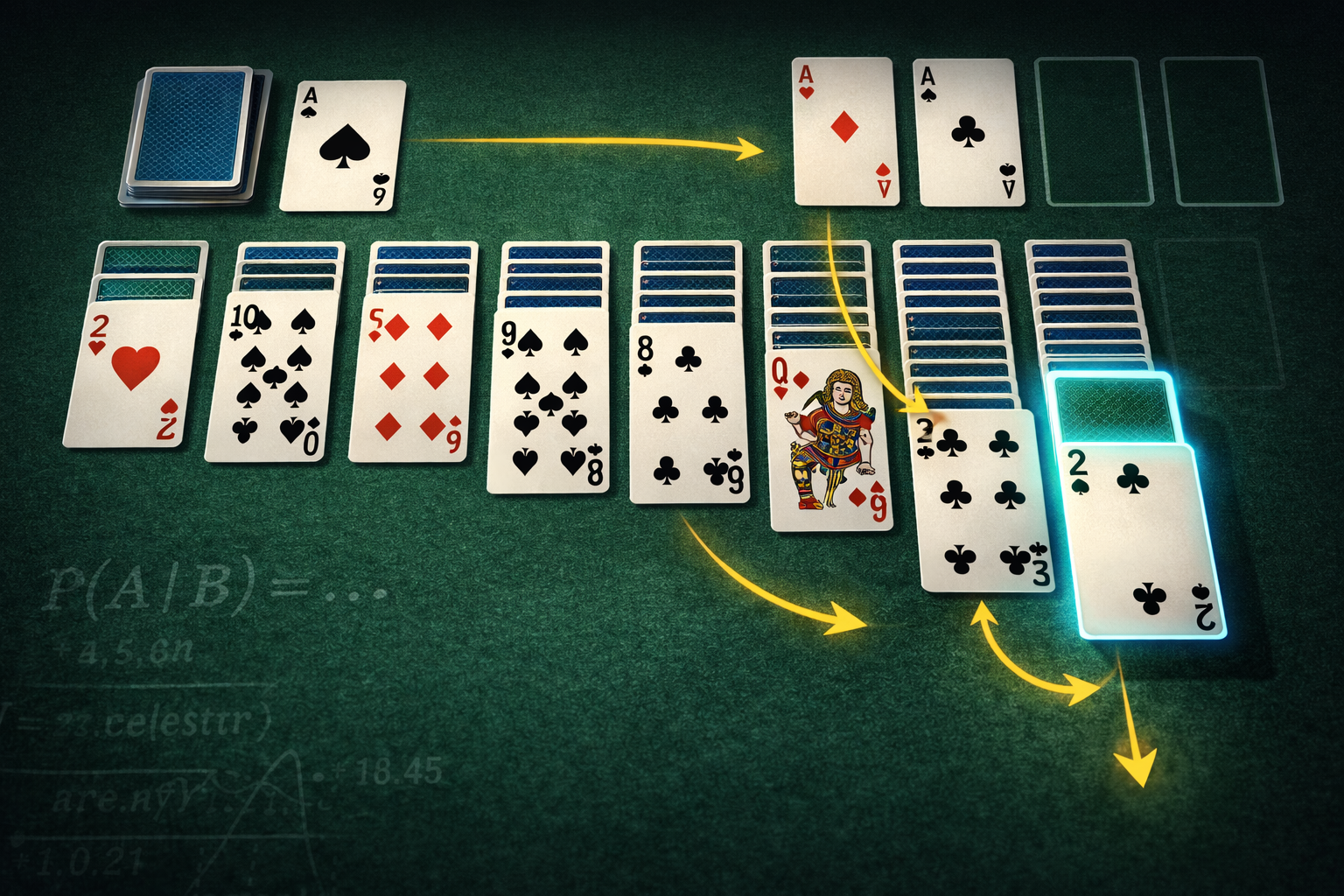
Solitaire may look like a simple card game — but winning consistently requires planning, patience, and disciplined decision-making.
If you already understand the basics, this guide will help you improve your strategy and increase your win rate.
If you’re new to the game, start here first:
👉 How to Play Solitaire (Complete Guide)
Ready to test your skills?
👉 Play Classic Solitaire Online
Is Solitaire a Game of Skill?
Yes — partly.
While the shuffle introduces randomness, skilled players consistently win more often because they:
- Reveal hidden cards efficiently
- Manage tableau space strategically
- Delay foundation moves when necessary
- Think multiple moves ahead
Your decisions matter more than luck.
Strategy #1: Reveal Hidden Cards First
The most important rule of Solitaire strategy is simple:
Always prioritize moves that uncover face-down cards.
Why?
Because hidden cards limit your options. The more visible cards you have, the more choices you gain.
When deciding between two possible moves, choose the one that reveals a hidden card.
More information = better decisions.
Strategy #2: Don’t Rush to the Foundations
It feels productive to move cards to the foundation piles quickly.
But doing so too early can actually reduce flexibility in the tableau.
Example:
If you move a 6 to the foundation, you can no longer use it to help reposition a 5 in the tableau.
Before sending a card to the foundation, ask:
- Will I need this card to build sequences?
- Does moving it block other options?
Strategic delay often increases your win rate.
Strategy #3: Empty Columns Carefully
Empty tableau columns are powerful — but they’re also limited.
Remember:
Only a King (or a sequence starting with a King) can fill an empty column.
Before clearing a column, make sure:
- You have a King ready to move
- That King will help reveal hidden cards
- The move improves your position
An empty column without a King is wasted space.
Strategy #4: Build Long Alternating Sequences
In the tableau, you must build down in alternating colors.
Instead of focusing on small moves, aim to create long, flexible sequences.
Longer sequences allow you to:
- Move more cards at once
- Clear columns more efficiently
- Reveal hidden cards faster
Plan for structure, not just movement.
Strategy #5: Think Several Moves Ahead
Solitaire rewards foresight.
Before making a move, pause and consider:
- What card will this reveal?
- Will this create a future block?
- Is there a better alternative move?
Many beginners lose because they react quickly instead of planning strategically.
Take your time. Winning Solitaire is not about speed — it’s about control.
Strategy #6: Use the Stock Pile Strategically
If you are playing draw-1 Solitaire, you have more flexibility.
If you are playing draw-3 Solitaire, planning becomes even more important.
When drawing from the stock:
- Don’t immediately play the first available card
- Check the tableau first
- See if a different move creates better alignment
Every stock draw should support your larger plan.
Strategy #7: Prioritize Aces and Twos — But Thoughtfully
Aces and Twos unlock foundation piles, which is helpful.
However, remember Strategy #2:
Don’t rush foundations blindly.
Move Aces early — but evaluate Twos carefully if they may assist tableau sequencing.
Strategy #8: Reset With Intention
If you get stuck, don’t rush to restart.
Instead:
- Review the board
- Look for alternative sequences
- Reassess foundation placements
Sometimes the solution is already on the board — you just missed it.
Common Strategic Mistakes
Avoid these frequent errors:
- Sending cards to foundation too early
- Ignoring hidden card priorities
- Clearing columns without a King ready
- Playing too quickly without evaluating alternatives
Winning players think differently.
Advanced Strategy: Control the Board
The best Solitaire players:
- Maintain tableau flexibility
- Avoid overcommitting to foundation piles
- Create space intentionally
- Maximize card visibility early
Solitaire is about managing constraints.
The more freedom you maintain in the tableau, the higher your win probability.
What Is a Good Solitaire Win Rate?
Win rate depends on the variation and difficulty.
For Classic Solitaire (draw-1):
- Beginners: 10–20%
- Intermediate: 25–35%
- Advanced players: 40%+
Improvement comes from disciplined strategy, not speed.
Practice With Purpose
Reading strategy is helpful — but practice is essential.
When you play, focus on:
- Revealing hidden cards first
- Managing empty columns carefully
- Thinking two or three moves ahead
Each game improves pattern recognition.
👉 Start a New Game of Classic Solitaire
Ready for a Greater Challenge?
Once you master Classic Solitaire, try a deeper strategic version:
👉 Play Spider Solitaire Online
Spider Solitaire requires even more planning and sequencing discipline.