

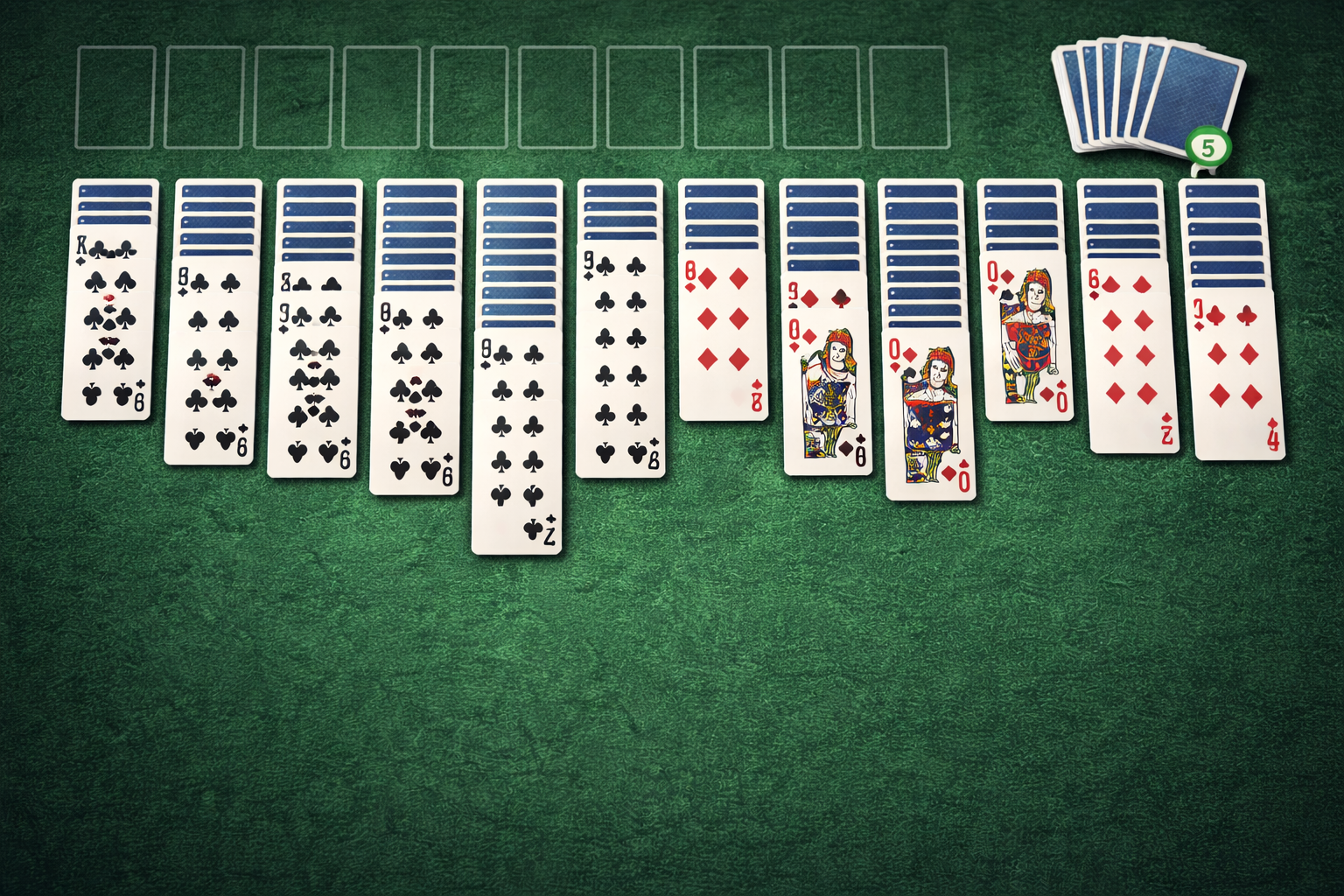
Spider Solitaire is one of the most popular variations of Solitaire. While it shares similarities with the classic version, Spider Solitaire introduces a different layout, additional strategy, and multiple difficulty levels.
Many players enjoy Spider Solitaire because it requires more planning and decision-making than traditional Solitaire.
In this guide, you will learn:
- the objective of Spider Solitaire
- the basic rules of the game
- how the tableau works
- the differences between 1-suit, 2-suit, and 4-suit modes
- beginner strategies for winning more often
If you want to try the game while learning, you can play here:
▶ Play Spider Solitaire
What Is the Goal of Spider Solitaire?
The goal of Spider Solitaire is to remove all cards from the tableau by creating complete sequences from King down to Ace of the same suit.
Once a full sequence is completed, it is automatically removed from the board.
To win the game, you must clear all sequences until no cards remain.
Spider Solitaire Game Setup
Spider Solitaire uses two standard decks of cards, totaling 104 cards.
The layout consists of:
- 10 tableau columns
- 50 cards dealt into the tableau
- 54 cards remaining in the stock pile
At the start of the game:
- the first four columns contain 6 cards each
- the remaining columns contain 5 cards each
- only the top card in each column is face-up
All other cards remain face-down until revealed during gameplay.
Basic Spider Solitaire Rules
Understanding the rules of Spider Solitaire is essential for playing successfully.
Cards Must Be Built in Descending Order
Cards in the tableau must be arranged from King down to Ace.
Example sequence:
King → Queen → Jack → 10 → 9 → 8 → 7 → 6 → 5 → 4 → 3 → 2 → Ace
Sequences Must Be the Same Suit to Be Removed
A sequence can only be removed from the board if all cards belong to the same suit.
Mixed-suit sequences can be built temporarily but cannot be cleared until completed in one suit.
Multiple Cards Can Move Together
If cards are arranged in descending order, they can be moved together as a group.
This makes it easier to reorganize columns and reveal hidden cards.
Empty Columns Can Hold Any Card
Unlike classic Solitaire, empty columns in Spider Solitaire can accept any card or sequence.
This creates powerful opportunities to reorganize the board.
Stock Cards Are Dealt When Needed
When no moves remain, you can deal a new row of cards from the stock pile.
Each column receives one additional card.
However, stock cards cannot be dealt if any tableau column is empty.
Spider Solitaire Difficulty Levels
Spider Solitaire offers three main difficulty levels.
1-Suit Spider Solitaire (Easy)
This version uses only one suit.
Because all cards match, completing sequences is easier.
This mode is ideal for beginners learning the game.
2-Suit Spider Solitaire (Medium)
Two suits are used in this mode.
Players must pay closer attention to card placement and sequence building.
This version introduces more strategy and planning.
4-Suit Spider Solitaire (Hard)
The hardest version uses all four suits.
Completing sequences becomes significantly more challenging because suit matching is required.
Advanced players often prefer this version.
Spider Solitaire Strategy for Beginners
Winning Spider Solitaire requires patience and strategic planning.
Below are a few tips that help beginners improve their gameplay.
Focus on Revealing Hidden Cards
Uncovering face-down cards should always be a priority.
More visible cards create more opportunities to build sequences.
Create Empty Columns
Empty tableau columns provide flexibility.
They allow you to temporarily move sequences and reorganize the board.
Build Same-Suit Sequences Whenever Possible
Mixed sequences are sometimes necessary, but same-suit sequences are easier to complete and remove.
Whenever possible, prioritize building sequences with matching suits.
Delay Using the Stock Pile
Drawing cards from the stock pile adds new cards to every column.
If the board is not prepared, these cards can block important moves.
Use the stock pile only when necessary.
Why Spider Solitaire Is More Strategic Than Classic Solitaire
Classic Solitaire focuses on moving cards to foundation piles.
Spider Solitaire, however, focuses on building long sequences within the tableau.
This creates a deeper level of strategy because players must constantly rearrange columns while planning several moves ahead.
Many experienced Solitaire players prefer Spider Solitaire because of this additional challenge.
Practice Spider Solitaire Online
The best way to understand the rules is to play.
Try a game now:
▶ Play Spider Solitaire
With practice, you will quickly improve your ability to build sequences and clear the board.
Frequently Asked Questions
What is the objective of Spider Solitaire?
The objective is to build complete sequences from King to Ace of the same suit and remove them from the board.
How many decks are used in Spider Solitaire?
Spider Solitaire uses two standard decks, totaling 104 cards.
Can any card fill an empty column?
Yes. In Spider Solitaire, any card or sequence can be placed in an empty column.
Which Spider Solitaire difficulty is best for beginners?
The 1-suit version is best for beginners because all cards belong to the same suit.

Do you have any lingering inquiries?
Experiencing difficulty locating the desired information? Reach out for a discussion.